

UPDATE Festival in Liepāja: Bringing cultural heritage to life digitally
The Update Festival organised by the Liepāja Academy of Riga Technical University (RTU) took place from 28 September to 3 October 2026. Ten workshops exploring aesthetic experience through technological approaches and methods of artistic research were led by international artists. Around 100 students from countries including Estonia, Latvia, Lithuania, Poland, Finland, Germany and Spain took part and presented their results to the public as interactive installations in the Media Lab.
In the workshop ‘Local Context: Liepāja as a Living Lab in Cultural Heritage Preservation’, led by Prof. Julia Schnitzer and Christoph Luchs, two groups examined different locations and topics in the Liepāja region. These included the bunker complexes in the Karosta district and the Seaside Park in the city.
Update-Festival_Liepaja_2026_07

Update-Festival_Liepaja_2026_01

Update-Festival_Liepaja_2026_02

Update-Festival_Liepaja_2026_03

Update-Festival_Liepaja_2026_04

Update-Festival_Liepaja_2026_05

Update-Festival_Liepaja_2026_06

Update-Festival_Liepaja_2026_08

Update-Festival_Liepaja_2026_10

Update-Festival_Liepaja_2026_09

Update-Festival_Liepaja_2026_11

Update-Festival_Liepaja_2026_12

Update-Festival_Liepaja_2026_13

Update-Festival_Liepaja_2026_14

Update-Festival_Liepaja_2026_15

Update-Festival_Liepaja_2026_16

Update-Festival_Liepaja_2026_17

Update-Festival_Liepaja_2026_18

Update-Festival_Liepaja_2026_19

Update-Festival_Liepaja_2026_20

Update-Festival_Liepaja_2026_21

Update-Festival_Liepaja_2026_22

Update-Festival_Liepaja_2026_23

Update-Festival_Liepaja_2026_24

Update-Festival_Liepaja_2026_25

Update-Festival_Liepaja_2026_26

Update-Festival_Liepaja_2026_27

Update-Festival_Liepaja_2026_28

Update-Festival_Liepaja_2026_29

Update-Festival_Liepaja_2026_30

Prior to this, the group visited Karosta Prison – a Soviet-era military prison which today offers visitors a harrowing insight into daily prison life and the psychological humiliation endured by the mostly young recruits. The prison was part of a military restricted area covering a large section of the city north of the harbour. These impressions were not only experienced on site, but also immediately recorded using photogrammetry.
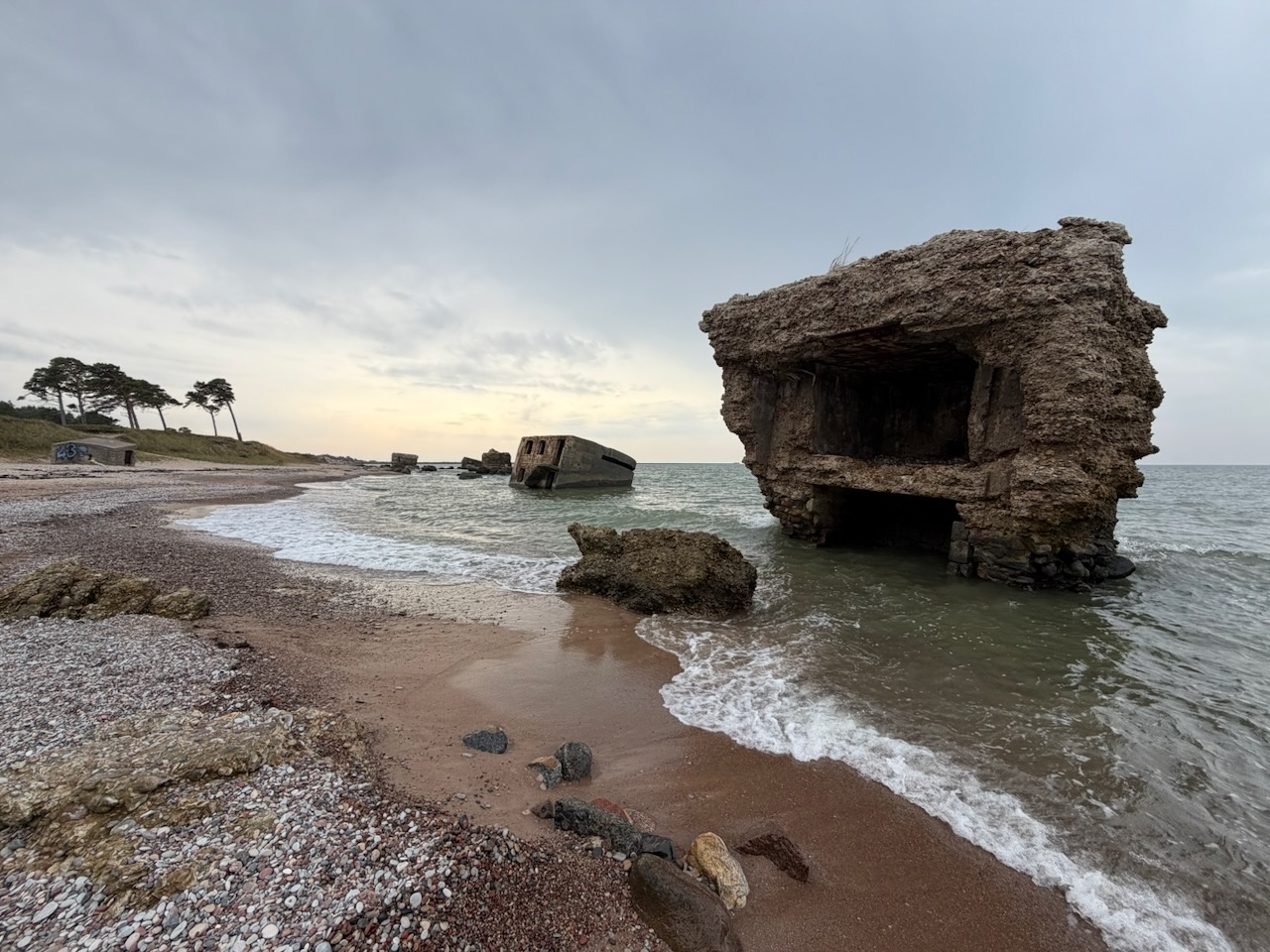
Adjacent to this, artillery bunkers were built to defend the military harbour. Once constructed, these proved to be a planning error and were subsequently rendered unusable. However, due to their massive dimensions, the bunker complexes could not be completely destroyed. The impressive remains – which stretch for several kilometres along the coast in three groups – are now freely accessible; they are gradually being reshaped by nature and serve as a canvas for graffiti.
Fragments in Time: Karosta Bunker
The group has named their project ‘Fragments of Time’ and presents visual experiences on a website in the form of 3D models, images and the historical background of the sites. The 3D presentation was created using photogrammetry and 3D scanning. The 3D models have also been adapted for viewing on VR headsets (Meta Quest 3), allowing all visitors to gain a direct impression of what the interior of a bunker looks like today. What is particularly impressive is not only the lifelike quality of the images, but also the direct experience of the dimensions, the raw structure of the surroundings and the graffiti on the interior and exterior walls of the bunker complexes.
You can view the website here: https://local-context.2026.updatefestival.lv
Seaside Park: Hands of Liepāja
In contrast, in the southern part of the city there is a wonderful sandy beach, which is visited by many tourists from both Latvia and abroad. A park was established behind the dunes over 100 years ago. Within this park there is a memorial to all musicians from Liepāja. This was the theme chosen by the second group of students. Five musicians from the well-known Latvian rock band ‘Livi’ have immortalised themselves there with their handprints in bronze sculptures – as have many other regional artists.
With their project ‘Hands of Liepāja’, the second group establishes a direct link between the location, music and traces – something that is scarcely perceptible at the actual site. The five selected handprints are presented as 3D models on a website. A separate biography can be selected for each musician. There are also musical examples. This allows visitors to plan their visit to Liepāja’s “Seaside Park” using the website as a starting point. But even visitors who are already familiar with this place have the opportunity to deepen their knowledge and make connections between the location, the music and the traces.
You can find the website here: https://shuvoislam41765.github.io/liepaja-bunker-3d/